- By Dick Fleming on Tuesday, August 11th, 2026 in Fabric & Furniture Protection, Furniture Care & Maintenance, News. No Comments
Nearly everyone who buys a white sofa braces for the same enemy: the wine spill, the coffee ring, the kid or dog who finds it before anyone else does. Those moments matter, and we’ll cover how to handle them. But in our experience protecting fabric for a living, the sofas that actually end up looking tired after a couple of years usually weren’t ruined by one dramatic spill. They gradually yellowed, and almost nobody saw it coming, including some who thought they’d already done everything right.
Protecting a white sofa comes down to two separate jobs: preventing individual stains from setting, and preventing the slow, whole-sofa yellowing that happens over months and years regardless of how careful you are with spills. A quality fabric protector, prompt blotting of spills, regular vacuuming, and limiting direct sun exposure address most of it. The part almost nobody mentions is that some fabric protectants themselves can contribute to yellowing over time if they aren’t formulated well or applied correctly, which means the product meant to protect the sofa can quietly work against you.
On a patterned or dark sofa, a faint discoloration blends in. On white, there’s no color to hide behind, so every change in tone is visible immediately, and there are really two separate things happening. Stains are sudden and localized: something spills, and if it’s not addressed quickly, it sets into a visible mark. Yellowing is different. It’s gradual, it spreads evenly across the whole piece rather than in a spot, and by the time it’s obvious, it’s usually too far along to fully reverse. Most advice online only addresses the first problem. The second one is arguably the bigger long-term risk to a white sofa’s appearance.
This is the part we see most consumer guides skip entirely, and it matters specifically for light and white fabrics. A fabric protector’s job is to coat the fibers so liquids bead rather than absorb, but older or lower-quality formulations, particularly some traditional fluorocarbon-based protectants, can break down over time with UV and heat exposure, and that breakdown can contribute to a faint yellow or amber cast on white fabric specifically, the same way certain plastics and finishes yellow with age. On a colored sofa, this kind of subtle shift is rarely noticeable. On white, it’s the whole story. A properly formulated, professionally applied protector shouldn’t cause this, but it’s worth knowing that “any fabric protector will do” isn’t quite true once white is the fabric in question, and it’s one of the reasons we treat light and white upholstery differently in how we approach application.
Once liquid hits the fabric, the first thirty seconds matter more than anything else:
If a protector has been properly applied, most everyday spills, coffee, wine, sauce, will bead on the surface long enough for a quick blot to lift the bulk of it before it ever penetrates the fibers. Without that layer, the same thirty seconds decides whether a spill wipes away clean or becomes a permanent mark.
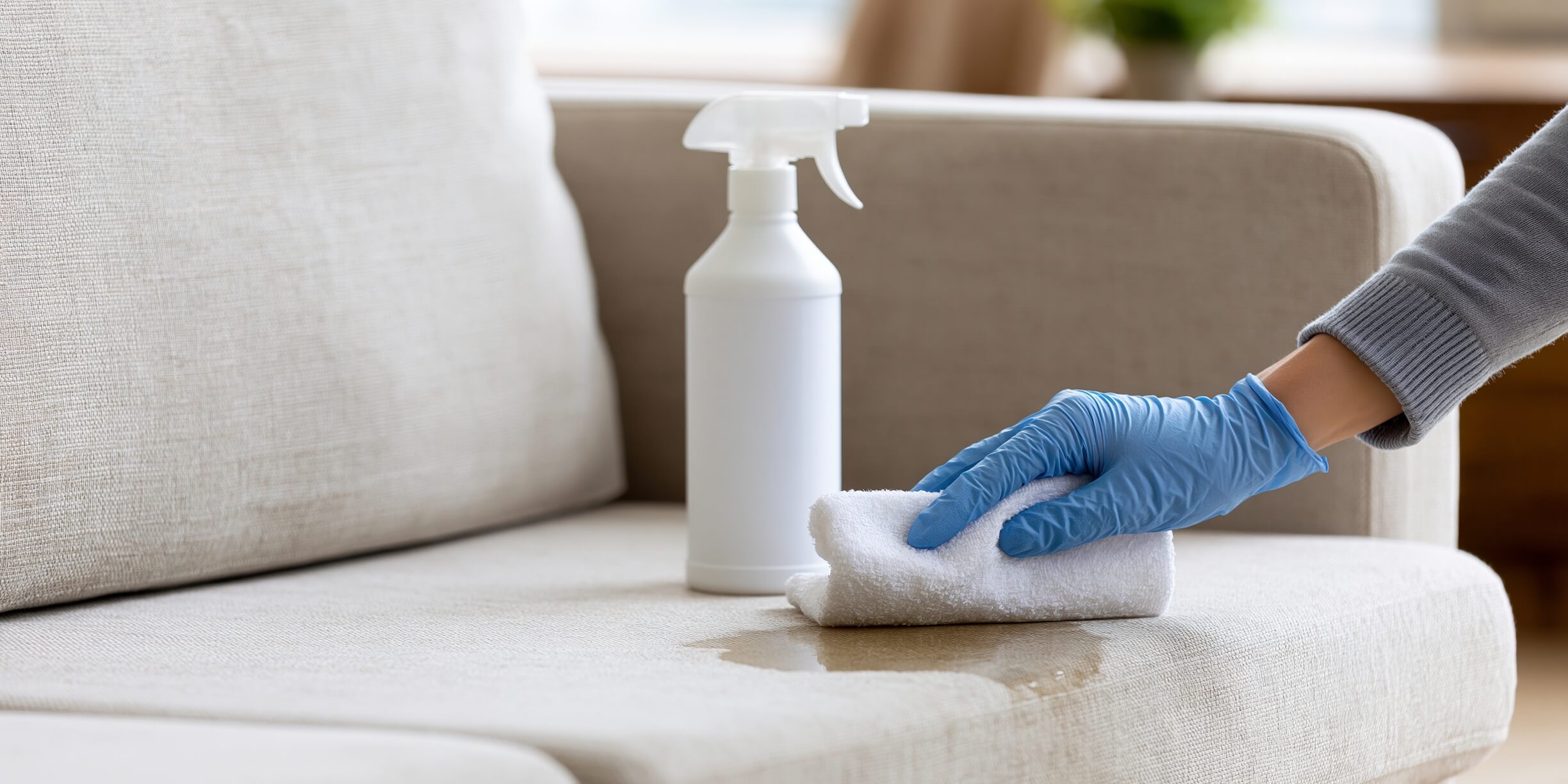
A few habits do most of the work here, and none of them involve reacting to a specific spill:
Periodic deep cleaning matters, but on white fabric it’s worth doing carefully. Over-wetting a section, using a cleaning product not formulated for the specific fabric type, or scrubbing too aggressively can all leave their own faint marks, sometimes worse than the stain being addressed. Testing any cleaning product on a hidden section first, using the least aggressive method that works, and avoiding oversaturating the fabric all reduce the risk of creating a new problem while solving the original one. Our guide on the five most common upholstery stains and how to remove them covers specific stain types in more detail if you’re dealing with something already set in.
A white sofa’s biggest threat usually isn’t the dramatic spill everyone braces for. It’s the slow, even yellowing that happens quietly in the background from sunlight, body oils, and sometimes the wrong protective product. Addressing both, quick response to spills and genuine protection against the slower stuff, is what actually keeps a white sofa looking new for years rather than months.
If you want your white or light-colored upholstery professionally protected the right way, Ultra-Guard Fabric Protection has specialized in on-site fabric protection for nearly 40 years. Our nanotech protective treatment is formulated to hold up over time without contributing to the yellowing that older protectants can cause. Learn more about our sofa protection service, or check out our approach to protecting luxury and delicate fabrics if your sofa is upholstered in a lighter, more sensitive material like linen or silk blend.
Yellowing on an unstained sofa is usually caused by UV exposure, oxidized body oils, or, less commonly, a breakdown in a fabric protectant applied to the piece. It’s a slow, cumulative process rather than the result of a single event, which is why it often goes unnoticed until it’s fairly advanced.
Yes, and it’s genuinely one of the more effective tools for preventing stains from setting. The key is using a protector formulated to hold up over time without contributing to discoloration, since not all products perform the same way on light fabric specifically.
Sometimes partially, through professional cleaning, but severe or long-standing yellowing, particularly from UV exposure or oxidized oils, is often difficult to fully reverse. This is part of why prevention matters more on white fabric than on most other colors.
Roughly every 12 to 18 months for most households, though homes with pets, kids, or heavy daily use often benefit from more frequent attention. Regular vacuuming and prompt spill care in between professional cleanings does most of the heavy lifting.