- By Dick Fleming on Wednesday, September 2nd, 2026 in Fabric Care & Stain Guide. No Comments

Most people who invest in an upholstered headboard think about it the same way they think about furniture: clean it when it looks dirty, and it will be fine. That approach works reasonably well on a sofa, where spills are visible and infrequent, and where the piece does not have contact with skin and hair for eight hours every night.
A headboard is different. It is in constant, repeated contact with hair products, skin oils, night creams, sweat, and whatever is on your hands when you reach back to adjust pillows. That contact happens nightly, invisibly, and the accumulation builds over weeks before it becomes visible as a darkened, slightly greasy band across the fabric at head and shoulder height. By the time most people notice it, the oils have bonded with the fibers and a standard cleaning will not fully remove them.
The strategy that actually keeps an upholstered headboard looking good is not reactive cleaning. It is understanding what the headboard is exposed to, addressing the fabric’s maintenance needs proactively, and protecting it before the exposure becomes a stain. Here is how that works in practice.
A sofa sees intermittent contact from clothing, occasional spills, and seasonal use patterns that allow for periodic cleaning between exposures. A headboard sees nightly skin and hair contact for hours at a time, from multiple people if the bed is shared, across every single day of the year.
The specific substances that headboards accumulate are also more difficult to address than typical upholstery soiling. Hair products, including dry shampoo, hairspray, and styling oils, are particularly problematic because they are designed to adhere to surfaces and resist water. When they transfer to fabric, they create a residue that traps airborne particles and accelerates visible soiling. Skin oils and night creams have a similar property: they penetrate the fibers rather than sitting on the surface, which means water-based cleaning agents alone will not fully remove them.
Velvet, linen, and bouclé headboards, which are among the most popular choices for their texture and visual warmth, are the most sensitive to this type of soiling because their fiber structures trap oils more readily than tighter weaves. That doesn’t mean they cannot be maintained; it means they need more consistent attention than a leather or vinyl alternative.
Every upholstered piece, including headboards, should have a cleaning code tag, typically attached to the underside of the piece or inside the frame. This code governs what cleaning agents are safe to use on the fabric.
If you do not know the cleaning code for your headboard fabric and cannot locate the tag, treat it as an S-coded fabric until you can confirm otherwise. Using water on an S-coded fabric can permanently damage the material, and the damage is not always reversible. When in doubt, a spot test in an inconspicuous location with whatever agent you plan to use is always the right first step.
The single most effective thing you can do for an upholstered headboard is vacuum it weekly using an upholstery attachment. This sounds like a minor step. In practice, it is the difference between a headboard that stays clean for years and one that requires professional cleaning every six months.
Vacuuming removes dry soil, hair, skin cells, and the fine particles that would otherwise become embedded in the fibers and act as an abrasive surface that wears the fabric down over time. For velvet and bouclé, use a soft brush attachment and work in the direction of the nap. For linen and other flat weaves, a standard upholstery nozzle works well.
The contact zone at head and shoulder height deserves specific attention. Run the vacuum attachment over this area slowly and methodically, not just a cursory pass. This is where oils and product residue concentrate, and regular mechanical removal of the dry-soil component keeps oils from bonding as deeply into the fibers as they would on an unvacuumed surface.
Even with consistent vacuuming, the oils from skin and hair products will gradually accumulate in the contact zone and require periodic attention beyond vacuuming alone. The frequency depends on how the headboard is used: a headboard that is leaned against nightly by someone who uses heavy hair products will need attention more often than one that sees lighter use.
For W and WS-coded fabrics, a mild upholstery cleaner applied to the contact zone with a clean white cloth, working from the outside of the affected area inward to prevent spreading, will address light buildup. Avoid saturating the fabric; the goal is light, targeted application with a clean cloth to blot rather than rub the area. Rubbing works the product deeper into the fiber structure and can damage the surface of velvet and textured fabrics.
For S-coded fabrics, a dry-cleaning solvent applied with a clean white cloth using the same blotting technique addresses oil buildup without the risk of water marks or shrinkage.
For stubborn buildup that has been accumulating for a longer period, a professional upholstery cleaning service is the appropriate next step rather than increasingly aggressive DIY cleaning attempts. More aggressive DIY cleaning on delicate fabrics risks permanent damage that professional cleaning could have avoided.
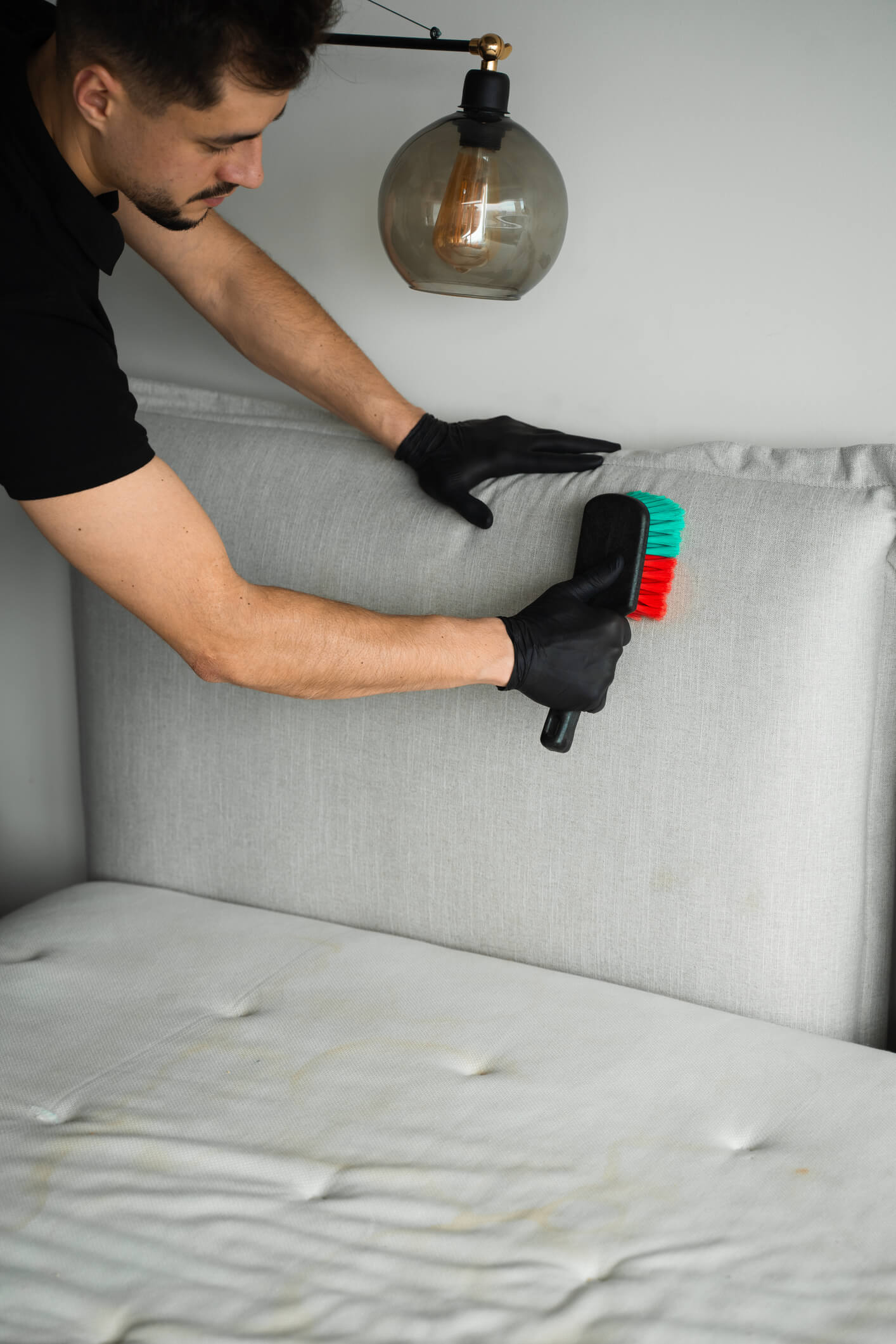
The most effective strategy for maintaining an upholstered headboard long-term is protective treatment applied before the fabric accumulates significant soiling. A professional-grade fabric protector creates a barrier at the fiber level that causes liquids and oils to bead on the surface rather than penetrate the weave, giving you time to blot and remove them before they become a stain.
Not all fabric protection products are equivalent. Consumer spray products, including aerosol silicone-based sprays, can leave residue, alter the hand feel of delicate fabrics, or yellow over time with UV exposure. Professional application of a nanotech fabric protector, applied at the correct coverage rate and with the appropriate equipment for the specific fabric type, creates a more durable and uniform protective barrier without altering the look, feel, or breathability of the material.
At Ultra-Guard Fabric Protection, our nanotech formula is applied on-site by certified technicians, and it works on all fabric types, including silks, velvets, linens, wool, and synthetic weaves, without altering color, texture, or hand feel. The treatment is silicone-free and will not yellow fabrics over time, which matters particularly for light-colored headboard fabrics that would show any discoloration. It is also non-toxic and safe for bedrooms with children and pets. Our fabric protection service includes a lifetime guarantee and a lifetime service warranty, which means if a covered stain doesn’t come out, we return to address it at no additional charge.
Headboards are one of the surfaces our technicians protect regularly, and they benefit from professional treatment for the same reason sofas and upholstered chairs do: the in-home, professional-grade application reaches uniform coverage on the fabric’s fiber structure in a way that consumer sprays applied from a distance cannot replicate.
Velvet is the most high-maintenance headboard fabric and also one of the most popular. The pile structure readily traps oils, hair product, and particulate matter, and a flattened pile from contact does not always recover without intervention. Steam brushing in the direction of the nap can restore crushed velvet pile; a soft-bristled fabric brush used after vacuuming keeps the pile direction consistent and prevents matting in the contact zone. Do not use water directly on velvet without confirming the cleaning code; many velvets are S-coded.
Linen is highly susceptible to water marking, which means cleaning must be done with care and the fabric dried quickly and evenly to prevent tide lines. Linen also wrinkles easily, so follow any cleaning with light smoothing while the fabric is slightly damp. Linen headboards benefit significantly from professional fabric protection because the protective barrier reduces the likelihood of water marks forming from accidental liquid contact.
Bouclé’s looped texture traps particulates and hair readily, making consistent vacuuming with a soft attachment especially important. The textured surface also makes stain removal more complex because the loops can hide soiling until it penetrates the base weave. Early intervention and protective treatment are particularly valuable for bouclé headboards.
Performance upholstery fabrics, marketed under various brand names, are engineered for durability and ease of cleaning and are more forgiving of water-based cleaning. Even performance fabrics benefit from professional protection, which extends their factory-applied treatment as it degrades with use and cleaning over time.
Beyond cleaning and protection, a few behavioral adjustments meaningfully reduce the rate at which a headboard accumulates soiling:
None of these fully eliminate the need for regular maintenance, but they reduce the rate of buildup and extend the time between professional cleaning appointments.
For a free quote on fabric protection for your headboard or other upholstered pieces, contact Ultra-Guard Fabric Protection at (866) 667-6685. Our certified technicians provide in-home application nationwide, and the initial protection treatment is the most cost-effective step you can take to extend the life and appearance of any upholstered piece in your home.
Hair oil that has penetrated fabric fibers requires a solvent-based approach for most fabrics. Check your headboard’s cleaning code first: W-coded fabrics can be treated with a mild upholstery cleaner; S-coded fabrics require a dry-cleaning solvent. Apply the appropriate cleaner to a clean white cloth and blot the affected area from the outside in, working gently to avoid spreading the stain or driving it deeper into the fiber. For buildup that has accumulated over a significant period, professional upholstery cleaning is more likely to achieve full removal without damaging the fabric than repeated DIY attempts.
Vacuuming with an upholstery attachment should happen weekly, particularly across the contact zone at head and shoulder height. Spot cleaning of visible soiling should happen as soon as it is noticed; the longer an oil-based substance remains in contact with fabric fibers, the more deeply it bonds and the harder it is to remove. A more thorough maintenance cleaning of the entire headboard surface is appropriate every three to six months depending on how the piece is used.
The discoloration that develops at head and shoulder height is caused by the gradual transfer of skin oils, hair products, and sweat onto the fabric during sleep. These substances are oily or waxy, so they penetrate the fiber structure rather than sitting on the surface. Over time, they attract and bond with airborne dust and particles, which is why the affected area darkens progressively. Regular vacuuming of the contact zone slows this process significantly by removing the dry-soil component before it can bond with the oils already in the fiber.
Baking soda can be useful as a dry deodorizer on W-coded fabrics: sprinkle lightly, allow it to sit for fifteen to twenty minutes, then vacuum thoroughly. It is not effective for removing oil-based staining. White vinegar is sometimes suggested as a spot cleaner, but use it with caution: it is acidic, can cause color changes on certain dyes, and can leave residue if not rinsed properly. For S-coded fabrics, use neither. If you’re unsure about a cleaning agent, test it in an inconspicuous spot and observe the result before applying it to the visible surface.
Water marks form when a liquid is applied unevenly to fabric, causing the outer edge to dry faster than the center and leaving a visible ring. To prevent them, dampen the entire surface lightly and evenly rather than applying liquid only to the soiled area, so there is no sharp boundary between wet and dry fabric as it dries. Work quickly and blot rather than rub. Keep the room well-ventilated while the fabric dries to encourage even, rapid drying. On linen and velvet in particular, a handheld steamer used lightly across the surface after cleaning can help the fibers dry evenly and restore the texture.